


January 16, 2025
BC Residential Property Flipping Tax (BC flipping tax)
The BC flipping tax was introduced by the BC government in its 2024 budget to impose tax on income earned from selling a property in BC if the property was owned for less than 730 days. The tax is expected to apply on properties sold January 1, 2025 onwards. Currently the law has not been enacted, but the draft legislation has received and passed third reading in BC Legislative Assembly.
Who does the BC flipping tax apply to
The BC flipping tax applies if a person (an individual, corporation, partnership or trust) sells or disposes of a taxable property on or after January 1, 2025. The net taxable income from a disposition within 730 days of the purchase may be subject to a new provincial tax.
Taxable property
The BC flipping tax applies to taxable property which means a beneficial interest in a residential property 1 or a right to acquire a beneficial interest in residential property. Generally, this includes properties with a housing unit, properties zoned for residential use, the right to acquire such properties i.e. the assignment of a purchase contract for a pre-build.
Application of the tax
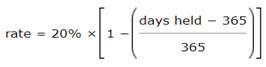
A 20% tax rate applies to net taxable income from sale of a property or assignment if taxable property is sold within 365 days of the purchase. If the taxable property is sold between day 366 to 730, the effective tax rate is gradually reduced to 0% by day 730. The below noted formula can be used to determine the applicable tax rate when calculating the BC flipping tax:
In addition, there is an available deduction of up to $20,000 if the property included the taxpayer’s principal residence and the taxpayer owned the property for at least 365 days. This is important to note as because the Income Tax Act provides an exemption to income tax for principal residences, the proposed BC Residential Property Flipping Tax does not.
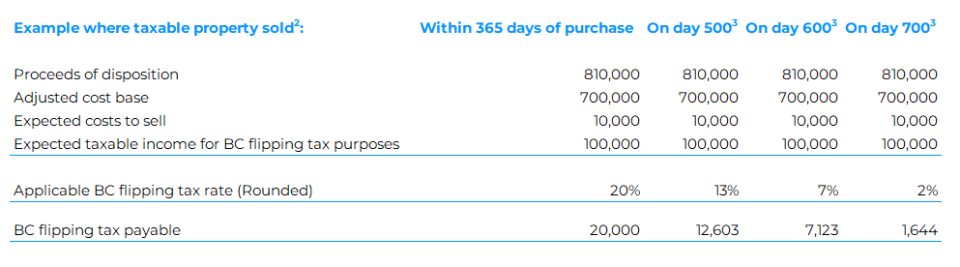
See below for application of BC flipping tax on a hypothetical scenario where taxable property is sold within 365 days of the purchase, on day 500, 600 and 700 from the date of purchase:
Exemptions from the tax
There are various exemptions from the tax, some of which have no filing requirement.
Exemptions that have no filing requirements (no need to file a return or pay the tax):
1. Exemptions for persons:
a) A registered charity
b) An association
c) The government, an agent of the government, various organizations included in the government reporting entity, other government and public bodies
d) An Indigenous nation 4
e) Corporations owned by a municipality, regional district or an indigenous nation
f) Non-profit organizations; and
g) Prescribed persons.
A Trust may be exempt if on the date of the taxable transaction the trustee or all of the beneficiaries of the trust are persons referred to in the exemptions above.
Similarly, a Partnership may be exempt if on the date of the taxable transaction, all of the partners in the partnership are persons referred to in the exemptions above.
2. Exemptions for residential property includes property located in any of the following:
a) A reserve 5
b) Nisga’a Lands
c) Nisga’a Fee Simple Lands as defined in the Definitions Chapter of the Nisga’a Final Agreement
d) shíshálh lands as defined in section 2(1) of the shíshálh Nation Self-Government Act (Canada)
e) Treaty lands of a Treaty First Nation
f) Maa-nulth First Nation Lands as defined in the Definitions Chapter of the Maa-nulth First Nations Final Agreement
g) Tla’amin Lands as defined in the Definitions Chapter of the Tla’amin Final Agreement
h) Tsawwassen lands as defined in the Definitions Chapter of the Tsawwassen First Nation Final Agreement
3. Exemption for specified beneficiaries – a person is a beneficiary of a real estate investment trust (REIT), as defined in section 122.1(1) of the Income Tax Act.
4. Property exclusively used for commercial use – note that the definition of commercial use or commercial purpose does not include any of the following:
a) holding the residential property for sale;
b) renovating the residential property for sale;
c) providing accommodation, under a tenancy agreement or a short-term vacation rental arrangement, in a housing unit that is part of the residential property;
d) a non-residential purpose carried out in a housing unit that is part of the residential property; and
e) a prescribed purpose.
Note that the property must be used exclusively for commercial purposes to be exempt under this provision, as a result any mixed use properties would not qualify for this exemption.
Exemptions that have a filing requirement but may exempt the person from having to pay the flipping tax:
Life circumstances for individuals:
1. Individual’s death or death of a related individual
2. Serious illness or disability
3. Eligible relocation (to carry on business, be employed, to be a full-time post-secondary student)
4. Change in household membership (related person moving in with you, you moving in with a related person, having or expecting a child).
5. Breakdown of marriage or common-law partnership
6. Involuntary termination of employment
7. Threat to personal safety
Life circumstances for individuals, corporations and partnerships:
1. Bankruptcy or insolvency
2. Housing unit was destroyed
3. Expropriation of the residential property
4. Property acquired through lottery
5. Death of an individual (property inherited through a will and sold thereafter).
6. Foreclosure
7. Estimated completion date delayed by more than 365 days (unable to wait for the completion of the property as the completion date has been extended by more than 365 days as compared to the original anticipated completion date).
Exemptions for builders and developers
1. You ordinarily buy and sell property for the purpose of constructing or placing buildings on the property, or construct or place buildings on property held for that purpose, and you held that taxable property for the purpose of constructing or placing buildings on that property.
2. A related person as part of their ordinary course of business buys and self property for the purpose of constructing or placing buildings on the property, or construct or place buildings on property held for that purpose, and you held that taxable property for the purpose of constructing or placing buildings on that property.
- Related individuals or individuals related to a corporation do not meet the related criteria for this exemption.
3. Carrying out building activity on land without a housing unit at the time of purchase.
- Purchase of a vacant lot to build a housing unit. Building activity includes site clearing, excavating, constructing or place the housing unit.
4. Substantial renovation of a home where all or substantially all of the housing unit has been removed or replaced other than the structural components.
5. Construction of a housing unit where a housing was demolished and a new housing unit is constructed or placed on that property.
Exemption for related individuals – An individual on sells their property to a related individual. Individuals are considered related if connected by blood relationship, marriage, common-law partnership or adoption.
Exemptions for persons related to corporations – A person (an individual, corporation or partnership, but not a trust) sells a property to a related corporation.
Primary residence deduction – allows up to a $20,000 reduction to taxable income if the property owner owns the property for at least 365 consecutive days, and the property includes a housing unit that is the primary residence of the property owner. This deduction is pro-rated if an owner sells a portion of their interest in the primary residence, and is not available on assignment/presale contract sales.
Filing a return and applicable penalties
If the BC flipping rules apply to sale of a taxable property and the applicable exemption still requires filing a return, a BC home flipping tax return must be filed within 90 days of the sale.
Failure to file or late filing may result in the property owner being subject to penalties equal to the greater of $500 or 5% of the unpaid tax, plus an amount determined by the formula: 1% x A x B. Where A is the greater of $500 and the remaining unpaid amount in regards to the BC flipping tax, and B is the number of months the return was filed late.
Conclusion
If you sold a taxable property on or after January 1, 2025, and held the property for less than two years, you may have a filing obligation. To file your return, visit the File a return for the BC home flipping tax page.
Still have questions?
Feel free to contact us if you have any questions on the BC flipping tax or any other real estate tax related matters.
Manning Elliott posts new blogs and up-to-date articles frequently concerning the most recent provincial and federal legislative changes.
NOTE: Tax laws are complex and are subject to frequent change. The contents of this Manning Elliott article are not intended to represent legal or tax advice. Please consult your tax adviser before employing any strategies that may have been discussed within this article.
1 Residential property means: (a) a housing unit located in British Columbia together with any land subjacent or immediately contiguous to the housing unit; (b) land located in British Columbia together with any building or other structure on or in the land if (i) the land is zoned all or in part for residential use, and (ii) no part of the land, building or other structure is otherwise included in paragraph (a).
2 For simplicity purposes, sale proceeds, adjusted cost base and expected costs to sell are assumed to be the same in each scenario.
3 Primary residence deduction may be available. Assumed not applicable in the scenarios mentioned within this article.
4 Indigenous nation- includes a band (as defined in section 2(1) of the Indian Act (Canada); the Nisga’a Nation; a Nisga’a Village; the shíshálh Nation continued under the shíshálh Nation Self-Government Act (Canada); the shíshálh Nation Government District continued under the shíshálh Nation Self-Government Act (Canada); a treaty first nation; the Westbank First Nation as defined in the agreement approved under the Westbank First Nation Self-Government Act (Canada); and a prescribed Indigenous entity.
5 As defined in section 2(1) of the Indian Act (Canada)- (a) means a tract of land, the legal title to which is vested in Her Majesty, that has been set apart by Her Majesty for the use and benefit of a band, and (b) except in subsection 18(2), sections 20 to 25, 28, 37, 38, 42, 44, 46, 48 to 51 and 58 to 60 and the regulations made under any of those provisions, includes designated lands; (réserve)